






What if the world’s most exclusive fairways were located just ten steps from your bedroom? Golf without limits. It's a dream that many golfers share, yet technical jargon often makes the process feel out of reach. You might worry that your ceilings are too low or that you'll buy parts that don't work together. We understand that choosing golf simulators for home should feel like an elite experience, not a confusing chore. In 2026, technology has advanced so much that premium systems now provide 99.4% accuracy compared to hitting on a real grass range.
We agree that your home should be a sanctuary for both relaxation and mastery. Your dream, realized. This guide simplifies the entire journey, turning complex terms like "photometric cameras" into clear, easy choices. You'll discover exactly how to measure your room for safety and how to select a premium, turnkey solution that fits your lifestyle. We've broken down every essential component so you can build your setup with total confidence. Let's explore how to create an unrivaled golfing experience that's ready for your first swing the moment it's installed.
Key Takeaways
- Learn how a home simulator uses a smart "brain" to track your ball, allowing you to play real golf indoors using your own clubs.
- Discover the four essential parts you need to build a safe and professional hitting area in your own home sanctuary.
- Master the simple room measurements required to find the best golf simulators for home that fit your space and your swing perfectly.
- Explore how easy-to-use software lets you play famous global courses like Pebble Beach from your living room, regardless of the weather.
- Understand why a custom, "turnkey" setup is the simplest way to ensure every piece of equipment works together for a premium experience.
What is a Home Golf Simulator and How Does It Work?
Imagine stepping into your garage or a dedicated media room and finding yourself standing on the first tee at Pebble Beach. A home golf simulator makes this possible. It's a professional-grade indoor system that allows you to play a full round of golf using your own real clubs and real golf balls. You hit the ball into a large, reinforced impact screen, and the technology instantly translates that physical hit into a digital flight. To understand the foundation of this technology, you might ask, What is a golf simulator? and how does it differ from a simple game? While a basic setup might feel like a toy, an elite system focuses on 100% accuracy and realism. It provides a high-end practice space that remains open 365 days a year, regardless of the weather outside.
The Three Main Jobs of a Simulator
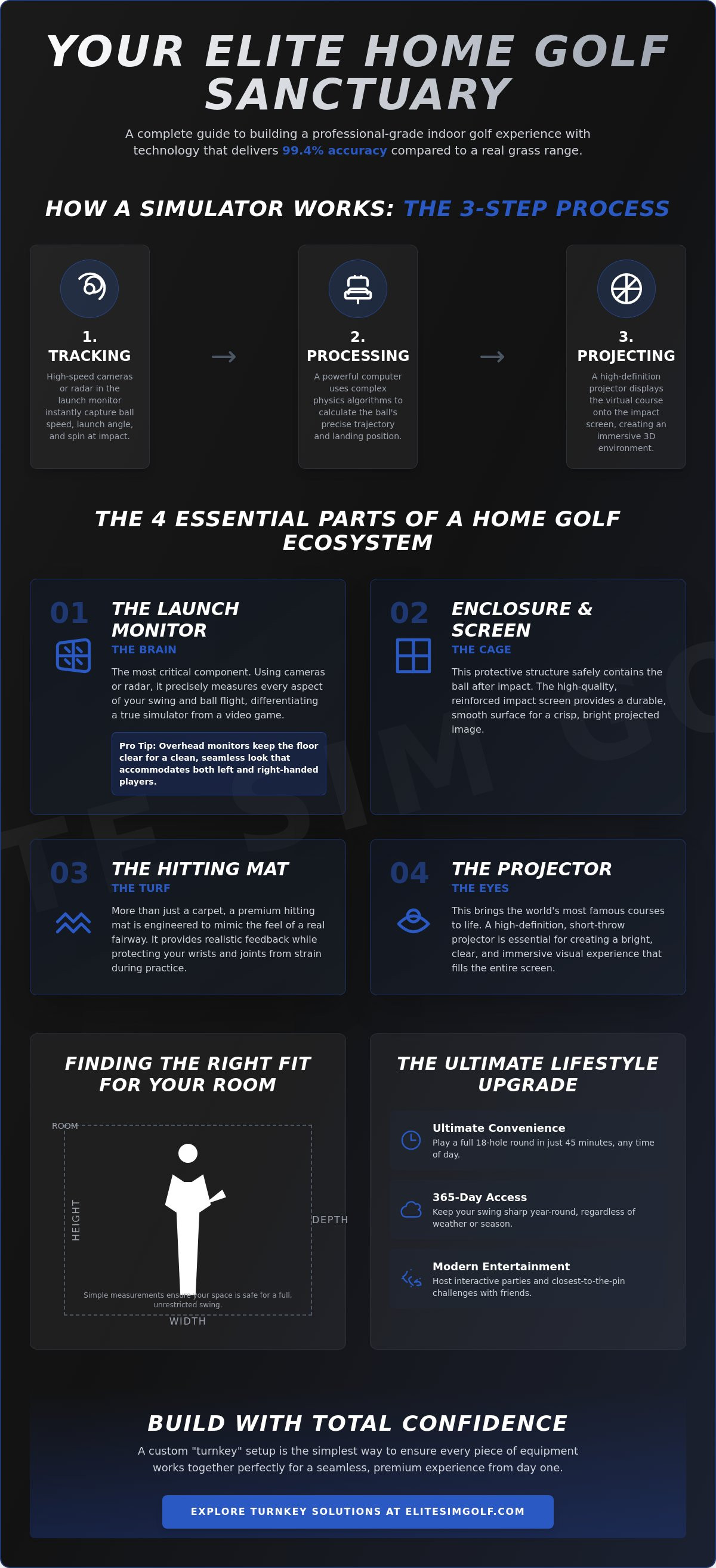
To create a seamless experience that feels like the real thing, the system performs three specific tasks in less than a second.
- Tracking: This is the most critical step. High-speed cameras or radar sensors, often called a launch monitor, watch your club and the ball at the moment of impact. They measure data points like ball speed, launch angle, and how much the ball is spinning.
- Processing: A powerful computer takes all that data and does the math. It uses complex physics to calculate exactly where your ball would land on a real grass course.
- Projecting: A premium projector displays the 3D world onto your screen. This creates a visual environment that makes you feel like you're standing in the middle of a lush fairway rather than in your basement.
Why Home Golf is the Ultimate Lifestyle Upgrade
Owning one of these systems is a transformative lifestyle choice for any golfer. Convenience is the primary benefit. You can play a full 18-hole round in just 45 minutes because there's no time wasted walking between shots or waiting for other groups. This efficiency allows you to keep your swing sharp during the winter months or on rainy days when the local course is closed. It's a bespoke sanctuary for personal improvement and mastery.
These golf simulators for home also serve as the centerpiece of a modern entertainment space. Instead of just watching a movie, you can host interactive parties where guests compete in closest-to-the-pin challenges. It's a turnkey solution that blends professional sports technology with luxury home design. You aren't just buying a piece of equipment; you're securing a gateway to an elevated golfing experience. Your dream, realized.
The 4 Essential Parts of a Home Golf Ecosystem
Building one of the best golf simulators for home involves more than just buying a net. You're creating a high-tech environment where every piece of equipment has a specific job. Think of it as a four-part team designed to bring the outdoor game inside your house. Each component must work in harmony to give you a realistic experience.
- The Launch Monitor: This is the "brain" of the system. It uses high-speed sensors to watch your ball the moment you hit it.
- The Enclosure and Impact Screen: This acts like a protective "cage." It stops the ball safely and provides a large, white surface for the picture.
- The Hitting Mat: This is a specialized turf. It protects your wrists and mimics the feel of real grass.
- The Projector: These are the "eyes." It shines a high-definition image of the course onto your screen.
Choosing the Brain: The Launch Monitor
The launch monitor is the most important part of your setup. It uses cameras or radar to track how fast the ball moves and which way it spins. To truly understand how this works, it helps to look at the physics of a golf swing, which involves complex forces and energy transfers. The monitor calculates these forces in milliseconds to show your shot on the screen. It's the difference between a video game and a true training tool.
Many homeowners prefer "overhead" units for their permanent setups. These are mounted on the ceiling, keeping the floor clear of wires and bulky gear. This creates a seamless look and allows both left and right-handed players to swing without moving anything. A premium choice for this setup is the VTrack Overhead Golf Launch Monitor, which stays out of the way while providing pro-level data. It's an elite solution for those who want accuracy without the clutter.
Hitting Surfaces and Safety Enclosures
You might think a regular rug will work, but your joints will disagree. A professional hitting mat is built with layers of foam and fiber to absorb shock. This prevents injuries like "golfer's elbow" that occur when hitting off hard, unforgiving surfaces. It also helps with "impact acoustics," which is a professional way of saying it makes the room quieter when you hit the ball. Quality mats are essential for a long-term golf simulators for home project.
The enclosure is your safety net. It prevents stray balls from hitting your walls or ceiling. You can choose a DIY kit or a bespoke design that matches your home decor. A well-designed setup looks like a natural part of your room, not a piece of gym equipment. If you're ready to start your journey, you can explore turnkey solutions that handle every detail for you. This ensures your home stays safe while you master your game.
Space and Technology: Finding the Right Fit for Your Room
Creating a sanctuary for your game starts with understanding your physical limits. You can't just pick a spot and hope for the best. Building one of the premier golf simulators for home requires a perfect harmony between your room's dimensions and the technology you choose. We focus on the "Big Three" measurements: width, depth, and height. If any of these are off, the experience feels cramped rather than elite. Your swing should feel free and powerful, never restricted by the fear of hitting a wall or a light fixture.
The technology that tracks your ball comes in two main styles. Camera-based systems use high-speed photography to capture the ball at the moment of impact. These are perfect for smaller indoor rooms because they don't need much space to see what the ball is doing. Radar-based systems work like a weather station; they use radio waves to follow the ball as it flies. Because radar needs to "see" the ball travel for a longer distance to get an accurate reading, these systems usually require much deeper rooms to function correctly.
Ceiling Height and Room Depth Requirements
Ceiling height is the most critical factor for safety and comfort. While you can technically swing in a room that is 9 feet tall, a height of 10 feet is the professional standard for a bespoke installation. This extra space ensures that even your tallest guests can swing a driver without hesitation. For room depth, we recommend at least 15 feet. This provides 8 feet of space for your swing and another 7 feet for the ball to travel toward the screen. Measuring is simple. Stand in the center of your space and swing your longest club in slow motion. If you feel any anxiety about the ceiling, the room is too short.
Floor-Mounted vs. Overhead Systems
Where you place your hardware changes the entire feel of the room. Floor-mounted units are small devices that sit on the grass mat next to the ball. They're accessible and easy to move, but they can be a tripping hazard in a high-end social setting. If you want a truly seamless and turnkey experience, overhead systems are the unrivaled choice. These units are mounted safely on the ceiling, completely out of the way of your clubs and feet.
Choosing an overhead unit like the VTrack overhead golf launch monitor solves a common headache for home owners. Since the sensors are looking down from above, both left-handed and right-handed players can play in the same session without moving the equipment. It's a sophisticated solution that keeps the focus on the game. Your space stays clean, professional, and ready for a round at any moment. This is golf without limits.
Software and Connectivity: Bringing the World to Your Home
If the launch monitor acts as the eyes of your system, the software is the brain. It's the engine that transforms a physical swing into a digital flight. This technology creates the virtual world you see on the screen. Without high-quality software, you are simply hitting a ball into a white sheet. With it, your room becomes a gateway to the most famous landscapes in the sport. You can play 18 holes at Pebble Beach or test your skills at St. Andrews without leaving your house.
Modern golf simulators for home offer two distinct paths. Some golfers focus on serious practice. They want precise data like club path and face angle to lower their handicap. Others prioritize family fun and social gatherings. The best systems provide a turnkey experience where the hardware and software talk to each other instantly. This means you don't have to be a computer expert to start playing. You just turn it on, grab a club, and swing. It's an elite level of convenience that makes the game more accessible than ever.
Popular Software Options for Beginners
GSPro has become a top choice for many owners. It's famous for its realistic physics and a library of over 500 courses created by the community. If you want the ball to bounce and roll exactly like it does on real grass, this is the standard. E6 Connect is another powerful option. It's known for stunning graphics and a user-friendly interface. It feels like a premium video game but maintains the accuracy professionals demand. You'll typically choose between a yearly subscription or a one-time fee. A subscription ensures you get the latest course updates and software patches automatically.
The Social Side of Home Golf
Your simulator is a social hub. You can join online tournaments and compete against golfers in different time zones. In 2025, online league participation grew by 35 percent, proving that home golf is a connected sport. If you have guests over, multiplayer modes like "Closest to the Pin" or "Longest Drive" contests provide instant entertainment. These games are easy for non-golfers to enjoy. When you aren't golfing, the high-definition projector and large impact screen work perfectly as a home theater. You can watch the Masters or a blockbuster movie on a massive scale. It's a bespoke upgrade that adds value to your entire lifestyle.
To ensure your software has the most accurate data to work with, consider a professional-grade tracking system. Explore the VTrack Overhead Launch Monitor to see how elite hardware powers a seamless virtual experience.
Creating Your Elite Home Setup with Confidence
Building a professional golf environment in your house shouldn't be a guessing game. When you look for golf simulators for home use, you'll see two main choices. You can buy a standard box from a big retail store, or you can choose a bespoke setup. A bespoke setup is designed specifically for your unique room. It accounts for your ceiling height, the width of your walls, and your personal goals. This custom approach ensures that the screen fits perfectly and the projector displays a clear, crisp image every time you play.
Bundles are the smartest way to start your journey. A bundle includes the hitting mat, the net or enclosure, the computer, and the sensor. When these parts come from one source, they're guaranteed to work together. You won't spend your Saturday afternoon on the phone with tech support trying to figure out why your ball isn't showing up on the screen. It's a seamless way to get started without the stress of matching different brands.
Why Partner with a Specialist?
Trying to build a simulator on your own often leads to a DIY headache. You might save a few dollars upfront, but you'll likely spend more later to fix mistakes. A specialist acts as your partner from the first measurement to the first swing. We provide concierge-level support; this means we're there to help with technical setup and software updates long after the first day. We use premium components like the VTrack system to ensure long-term satisfaction. This overhead launch monitor uses high-speed cameras to catch every detail of your shot. It's the same technology used by professionals to refine their game, now simplified for your house.
Your Journey to Mastery Starts Here
The transformation from an empty room to a premium golf sanctuary is a powerful experience. It changes how you spend your time. Instead of driving to a range, you walk down the hall. Our turnkey advantage means you get everything you need in one reliable package. We handle the details so you can handle the clubs. Since our start, we've focused on making elite technology accessible to every dedicated golfer. You're not just buying equipment. You're investing in a lifestyle upgrade that removes the limits of weather and time.
Your dream is ready to be realized. Use our custom builder tool to visualize your dream setup and see how golf simulators for home can fit into your life. Start building your custom elite simulator today and take the first step toward mastering your game from the comfort of your own sanctuary.
Step Into the Future of Your Golf Game
Creating a professional practice space is now simpler than ever. You've seen that modern golf simulators for home work by combining four main pieces: a ball-tracking sensor, a durable hitting screen, a bright projector, and a high-quality mat. These parts work together to let you play on famous courses without leaving your house. As an authorized dealer for premium brands like Uneekor and Garmin, we provide the same high-level data used by the pros.
You don't have to worry about the technical setup on your own. Our bespoke custom simulator builder tool guides you through every step to ensure your equipment fits your room perfectly. We provide expert national support and reliable shipping to make your project feel effortless. This turnkey approach means you get a luxury experience from the first click to the final swing. We're here to act as your personal consultant throughout the entire process.
Build Your Dream Home Golf Simulator Today
It's time to turn your vision into a reality. You're just one step away from a lifestyle upgrade that brings the joy of golf into your daily routine.
Frequently Asked Questions
How much space do I really need for a home golf simulator?
You need a room that's at least 10 feet wide, 12 feet long, and 9 feet high. This ensures you can swing your longest club without hitting the ceiling or walls. While some setups work in smaller areas, the 10 by 12 by 9 footprint is the elite standard for safety. It gives you enough room to move naturally. Your dream, realized. This space creates a sanctuary for improvement.
Can I use my own golf clubs and balls with a simulator?
Yes, you can use your standard set of golf clubs and any brand of golf ball with your system. The sensors track the movement of your specific equipment regardless of the manufacturer. Using your own gear makes the experience feel unrivaled and authentic. It's the best way to practice your swing with the tools you actually use. This setup ensures your transition to the grass is completely seamless.
Is it hard to set up the software and projector myself?
Setting up modern golf simulators for home is much simpler than it was in 2020. Most software now uses plug and play technology that guides you through a 15 minute calibration process. We provide turnkey solutions that remove the technical stress of installation. If you can connect a laptop to a television, you can handle this. You'll be playing on world-class courses in less than an hour.
What is the difference between a launch monitor and a full simulator?
A launch monitor is the small device that tracks your ball data, while a full simulator includes the screen, projector, and hitting mat. Think of the launch monitor as the brain of the operation. The simulator is the entire body that creates the immersive world you see. You need both to create a truly elite environment. It's a bespoke experience that brings the course to you.
Do I need a special computer to run the golf software?
You need a computer with a dedicated graphics card, specifically something equivalent to an NVIDIA RTX 3060 or better. Standard office laptops don't have the power to render 4K golf courses at 60 frames per second. This hardware ensures the grass looks realistic and the ball movement stays smooth. Always check the specific software requirements to avoid any lag during your virtual rounds. Your performance deserves unrivaled clarity.
Is a home golf simulator safe for kids and beginners to use?
These systems are very safe for all ages as long as you maintain a 6 foot safety buffer around the golfer. Beginners benefit from the instant feedback provided by high-speed cameras. Because the hitting area is enclosed by padded walls, the ball stays contained. It's a seamless way for children to learn the basics. This controlled environment creates a sanctuary for growth and family connection.
Can I play other games or watch movies on the simulator screen?
You can use the large impact screen as a high-definition home theater for movies or gaming. Since the projector connects to your computer via a standard HDMI cable, it works just like a massive television. You can watch a football game on a 150 inch screen or play your favorite console games. This versatility turns your golf simulators for home into a multi-purpose entertainment hub for the family.
What happens if I hit a ball off the side of the screen?
Side nets or padded enclosures catch any balls that miss the main impact screen. These safety features are designed to stop a ball traveling at 150 miles per hour instantly. Most premium setups include these side barriers as a standard part of the installation. You won't have to worry about damaging your walls or furniture even if you hit a wild shank. Your home remains protected while you chase mastery.
Find similar articles:
golf simulators for home
