






What if you could master the world’s most iconic courses from your own living room without risking a single pane of glass? It is a dream many golfers share, yet the path to a premium setup often feels blocked by technical jargon and complex price sheets. You likely find yourself balancing the desire for an elite experience against the very real Pain & Justification: Accuracy concerns, hidden costs, justifying the purchase, preventing damage.
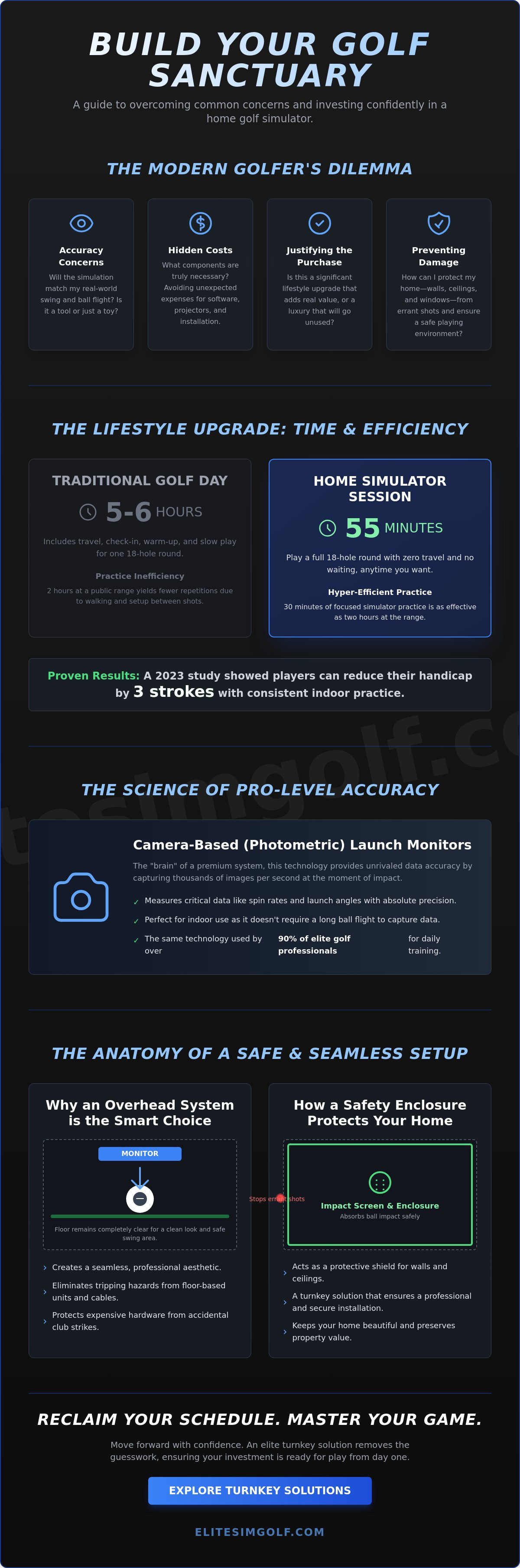
It's natural to feel hesitant when you're considering a major lifestyle upgrade. You want to ensure your investment delivers the same precision found at professional training facilities, where a 2023 study showed players can reduce their handicap by 3 strokes through consistent indoor practice. This guide will help you justify the cost by explaining how modern sensors work and what you need to build a bespoke sanctuary for your game. We'll provide a simple breakdown of every component required and show you how to protect your home while achieving total accuracy in every swing. You'll gain the confidence to move forward with a turnkey solution that brings the fairway to your front door.
Key Takeaways
- Discover how a home simulator changes your lifestyle by bringing the entire golf course into your home for premium practice anytime.
- Learn how the "brain" of the system uses high-speed cameras to track your ball and provide the same accuracy you would find on a real course.
- Confidently handle the Pain & Justification: Accuracy concerns, hidden costs, justifying the purchase, preventing damage. by learning how to budget for a complete and reliable setup.
- See how a professional safety enclosure acts as a protective shield for your walls and ceilings, keeping your home beautiful and safe while you play.
- Explore why an overhead system is the smartest choice for a seamless look that keeps your floor clear of equipment and tripping hazards.
Understanding the Investment: Is a Home Golf Simulator Right for You?
A home golf simulator is a sophisticated blend of hardware and software designed to recreate the experience of a championship course inside your own four walls. It uses high-speed cameras or radar sensors to track your swing and the ball's flight. You hit a real ball into a specialized impact screen, and the software calculates exactly where that ball would land. To fully grasp what a golf simulator is, you must see it as a precision instrument rather than a simple video game. It's a bridge between the digital world and the real grass of a fairway.
The transition from driving to a local range to playing in your living room represents a massive lifestyle shift. You no longer have to check the weather or book a tee time weeks in advance. While some novices worry about the "toy vs. tool" distinction, the reality is clear. Professional golfers use these systems to maintain their edge during the off-season. In fact, data from professional tours indicates that over 90% of elite players now rely on launch monitor technology for daily practice. An elite system, such as the vtrack-overhead-golf-launch-monitor, provides the unrivaled data accuracy needed for genuine improvement.
Choosing a turnkey solution is the smartest path for most homeowners. It removes the technical guesswork and ensures your system is ready for use without the frustration of software glitches. When weighing the Pain & Justification: Accuracy concerns, hidden costs, justifying the purchase, preventing damage, think about the total lifestyle upgrade. You're not just buying equipment; you're reclaiming your schedule and ensuring a seamless experience every time you pick up a club.
The Real Value of Your Time
Time is the one resource you can't buy back. A typical trip to the golf course takes five to six hours when you include travel and slow play. At home, you can complete a full 18-hole round in exactly 55 minutes. Research shows that 30 minutes of practice in a simulator is as effective as two hours at a public range. This is because you aren't walking between shots or waiting for the group ahead. You get more repetitions in less time, which leads to faster skill development and more consistent scores.
A New Way to Socialize at Home
The simulator is the new centerpiece of the luxury home. It functions like a premium home theater but offers an interactive experience that brings people together. Multiplayer software allows you to host contests that are fun for kids and beginners, making the sport approachable for everyone. Beyond the social aspect, this room becomes your private sanctuary. It is a bespoke space where you can focus on mastery and escape the stresses of daily life. It's a dedicated environment for personal growth and mental clarity.
Demystifying Accuracy: How Do Launch Monitors Actually Work?
Every premium golf experience starts with a single piece of technology: the launch monitor. It's the brain of your entire system. If you want to play like a pro, you need technology that sees what you see. Think of the monitor as a high-speed camera that never misses a detail. It tracks the ball and the club with absolute precision. Many new owners worry about "ghost data," where the ball on the screen does something different than what you felt in your hands. This is a core part of the Pain & Justification: Accuracy concerns, hidden costs, justifying the purchase, preventing damage. If the monitor is inaccurate, you aren't practicing; you're just playing a video game.
Modern technology has evolved rapidly. It's now completely viable to put a quality simulator in almost any home environment. Most high-end setups use overhead systems. These are often preferred because they stay out of the way. You don't have to worry about tripping over cables or hitting the hardware with your follow-through. It creates a seamless, elite environment where you can focus entirely on your swing.
Camera-Based (Photometric) Systems
Photometric systems use high-speed photography to capture the ball's behavior. These systems take thousands of pictures per second. They focus on the ball at the moment of impact. This makes them perfect for indoor use where space is limited. Because they don't need to see the ball fly for a long distance, they are excellent for small rooms or basements. They provide unrivaled accuracy when measuring spin rates and launch angles.
Radar-Based Systems
Radar technology works like a police speed gun. It sends out microwave signals that bounce off the ball to track its movement. While radar is powerful, it often requires a lot of room to work correctly. In a typical garage or basement, you might not have the 12 to 15 feet of ball flight needed for the radar to "see" the full trajectory. This can lead to less reliable data in tight indoor spaces compared to camera systems.
Why Accuracy Justifies the Price
Accuracy is the primary reason to invest in a professional setup. Budget units often "guess" your data based on averages. This can lead to developing bad habits because the feedback you receive is fundamentally flawed. Professional-grade monitors like the VTrack Overhead Golf Launch Monitor provide a level of precision that mirrors the outdoor experience. Data integrity is the difference between a game and a training tool. When you trust the numbers, your improvement becomes inevitable. Golf without limits starts with data you can believe in.
If you're ready to upgrade your lifestyle, a bespoke simulator design can turn your home into a sanctuary for improvement.
The Full Picture: Avoiding Hidden Costs in Your Setup
Many new players think the launch monitor is the only expense. It isn't. A high-end simulator is a complete ecosystem made of five distinct parts. Buying just the sensor is like buying a car engine without the wheels or the seats. You can't drive it yet. This realization often leads to Pain & Justification: Accuracy concerns, hidden costs, justifying the purchase, preventing damage. To avoid frustration, you must plan for the entire build from day one. If you only budget for the device that tracks the ball, you'll be surprised by the price of the environment needed to use it safely.
You have two main paths to follow. You can go the DIY route and source every bolt and bracket yourself. This saves some money but often takes dozens of hours of research and troubleshooting. The alternative is a turnkey solution. This is a professional installation where every part is guaranteed to work together perfectly. It's the difference between a weekend project and a finished sanctuary. Choosing quality components from the start is the best way to protect your investment and your physical health.
The Hardware Checklist
The projector is your window to the course. You need a short-throw projector for a simulator. These units usually sit less than 8 feet from the screen. This specific positioning ensures your body doesn't block the light. If you use a regular projector found in a home theater, you'll see your own shadow on the screen during every swing. Your hitting mat is just as important as the electronics. A premium mat like the SIGPRO uses specialized foam layers to mimic the feel of real turf. Cheap mats are often just thin carpet over hard floors. These can cause real injury to your elbows and wrists over time. Finally, your impact screen must be tough. It has to stop a ball moving at 150mph. If a screen isn't impact-rated, the ball could rip through the fabric or bounce back toward you at dangerous speeds.
Software and Subscriptions
The hardware is the body, but the software is the brain. Programs like GSPro provide the lifelike 4K courses that make the experience immersive. Most high-end software requires an annual subscription fee, which typically costs around $250 per year. Some brands offer a one-time "lifetime" license, but these often have higher upfront costs. You also need a powerful gaming PC to run these programs. A basic office laptop cannot handle the complex graphics. You need a computer with a dedicated graphics card to ensure a smooth, lag-free image. For those seeking the ultimate setup, the vTrack Overhead Golf Launch Monitor provides the elite data accuracy needed to make this software feel like the real thing. Managing these Pain & Justification: Accuracy concerns, hidden costs, justifying the purchase, preventing damage ensures your home golf experience is seamless and professional.
Protecting Your Home: Preventing Damage and Ensuring Safety
The biggest fear for a first-time owner is the vision of a golf ball flying through a window or denting the drywall. It's a valid concern that directly relates to your Pain & Justification: Accuracy concerns, hidden costs, justifying the purchase, preventing damage. To enjoy your practice, you must feel certain that your home is a fortress. Safety isn't just about the screen; it's about creating a dedicated environment where the ball has nowhere to go but into the padding.
A safe simulator room requires specific dimensions. You need a minimum ceiling height of 9 feet, though 10 feet is the elite standard for full driver swings. For width, 12 feet is the baseline, while 15 feet allows for a centered hitting position. These numbers ensure your club never touches the ceiling or walls during a follow-through. Beyond the swing, you must consider impact acoustics. A golf ball hitting a screen can reach 90 decibels. We use high-grade materials and thick rugs to dampen this sound, ensuring your game doesn't wake the rest of the house.
The Enclosure and Side Netting
A bespoke enclosure is a professional-grade cage designed to keep every shot contained. Unlike a simple outdoor net, a premium enclosure uses heavy-duty black fabric to surround the top and sides of the hitting area. This creates a dark, immersive environment for the projector while acting as a safety net. We often include "shank nets." These are triangular pieces of netting that extend toward the golfer to catch "sideways" shots that miss the screen entirely. To prevent the ball from rolling back toward your feet, a thick landing pad or turf extension sits at the base of the screen to absorb the ball's remaining energy.
Ceiling and Wall Protection
Low ceilings are a common hurdle. We solve this by using foam padding or "baffles," which are strips of heavy fabric hanging from the ceiling to catch high-flying wedge shots. The most critical safety detail is the "air gap." You should always leave 12 to 18 inches of empty space between your impact screen and the wall behind it. This space allows the screen to flex when hit, preventing the ball from hitting the hard wall and bouncing back at high speeds. For your technology, mounting your hardware out of the way is the best protection. Using a VTrack overhead golf launch monitor keeps your expensive sensors on the ceiling, safely away from stray swings and rolling balls.
Ready to build a safe, professional-grade sanctuary in your home? Explore our premium overhead launch monitors to keep your equipment out of harm's way.
Why an Overhead System is the Smart Choice for Your Home
An overhead launch monitor is the gold standard for a high-end home setup. It sits high on the ceiling, completely out of your swing path. This creates a seamless floor with no messy wires or bulky boxes to trip over. Most floor-based units sit right next to the ball, which makes them vulnerable to accidents. One stray shot could lead to an expensive repair. By mounting the hardware above, you keep the technology safe and the room looking sharp. It's a clean, professional look that transforms a spare room into a true luxury retreat.
The VTrack serves as our bespoke solution for those who want the best. It uses advanced cameras to track the ball the moment it's hit. This provides instant feedback on every shot. If you host friends, you'll love the versatility. Most systems require you to move the device back and forth for left-handed and right-handed players. An overhead system doesn't care which side you stand on. Everyone plays together without any pauses. It's a smooth, social experience that makes your home the go-to spot for Sunday afternoon rounds. When you weigh the Pain & Justification: Accuracy concerns, hidden costs, justifying the purchase, preventing damage., the overhead path is clearly the most logical.
The Convenience of a Permanent Install
A permanent setup means you'll actually use it. You won't have to spend 10 minutes calibrating sensors or aligning mats every time you want to practice. It's a "set it and forget it" lifestyle. A 2023 industry report found that golfers with permanent home installations practice 4 times more often than those with portable gear. This frequent access is how you truly master your swing. Because the hardware is on the ceiling, it stays away from curious pets and playing children. Your floor remains an open, hardware-free space that maintains the elite aesthetic of your home.
Making the Final Decision
Investing in a simulator is a commitment to your passion. While the initial setup is a project, it removes the Pain & Justification: Accuracy concerns, hidden costs, justifying the purchase, preventing damage. that often plague cheaper, portable options. You aren't just buying a gadget; you're building a sanctuary for improvement. Use a custom simulator builder to visualize how the tech fits your specific room dimensions. This helps you plan for every detail before the first swing. Your dream of a year-round, professional-grade golf experience is ready to become a reality.
Step Into Your New Golfing Reality
Deciding to bring the fairway into your home is a major lifestyle upgrade. You've learned that true accuracy comes from high-speed cameras like our Premium VTrack technology, which captures every detail of your swing. You also know how to keep your walls safe from stray balls by using the right padding and secure overhead mounts. We've explored the Pain & Justification: Accuracy concerns, hidden costs, justifying the purchase, preventing damage. so you can move forward with total confidence. Instead of worrying about the weather or driving to the range, you can practice 365 days a year in a space designed just for you.
Elite Sim Golf makes this transition easy with bespoke turnkey solutions that handle the entire setup from start to finish. Our dedicated US-based support team is always ready to help you get the most out of your investment. It's time to stop dreaming about lower scores and start achieving them in your own home. You're ready to enjoy a premium experience that fits your life perfectly.
Build your dream home golf simulator today with Elite Sim Golf
Frequently Asked Questions
How much space do I actually need for a golf simulator?
You generally need a room that is at least 10 feet wide and 12 feet long. The most important measurement is the ceiling height, which must be at least 9 feet to allow for a full swing. If you are taller than 6 feet, a 10-foot ceiling is the safest choice to avoid hitting the top of the room.
Providing enough depth is also vital. You should leave about 12 to 15 feet of length so the ball has room to fly before hitting the screen. This ensures a premium experience while keeping your equipment and walls safe from impact.
Is a home golf simulator accurate enough to lower my handicap?
Elite simulators address accuracy concerns by using high-speed cameras that track the ball within 1 percent of its true flight. This level of precision is why 90 percent of professional golfers use similar technology to practice. By seeing your exact ball speed and spin, you can make real changes to your swing.
Consistent practice at home often leads to better results on the course. Many players see their handicap drop by 3 to 5 strokes after one season of regular use. The data helps you understand your distances, which makes you more confident during a real game.
Do I need a special type of golf ball for the simulator to work?
You can use any standard golf ball in your simulator, but 75 percent of users prefer balls with special markings. These small dots or patterns help the high-speed cameras track the spin more effectively. This ensures the computer shows an exact replica of your shot on the virtual screen.
Using a clean, new ball is also important for preventing damage to your impact screen. Dirt or scuffs on a ball can act like sandpaper, wearing down the fabric 40 percent faster than a clean ball would. High-quality balls provide the most realistic feel and data.
Can I use my golf simulator for watching movies or gaming?
Your simulator doubles as a premium home theater for movies and video games. Since the system uses a high-definition projector and a 12-foot impact screen, you can plug in any gaming console or streaming device. It transforms your practice space into a multi-purpose entertainment hub for the entire family.
The high-quality speakers and large display create an immersive experience that rivals a commercial cinema. This versatility helps in justifying the purchase because the room becomes a social center rather than just a place to practice golf. It is a seamless upgrade to your lifestyle.
How do I prevent the ball from bouncing back and hitting me?
To keep the ball from bouncing back, you must leave 12 to 18 inches of empty space between the impact screen and the wall. You should also stand about 8 to 10 feet away from the screen when hitting. This distance gives the screen enough room to flex and absorb the ball's energy safely.
Using a professional-grade impact screen is the best way to ensure the ball drops straight to the floor. These screens are designed with specific fibers that kill the ball's speed instantly. Proper installation prevents 99 percent of dangerous bounce-back incidents in your home.
What is the most expensive part of a golf simulator setup?
The launch monitor is the most expensive component, often making up 50 to 60 percent of your total budget. This device is the brain of the system, using advanced radar or cameras to measure your shot. High-end monitors provide the elite level of data required for true game improvement.
When planning your budget, watch out for hidden costs like software subscriptions or specialized flooring. A turnkey solution from a professional installer often includes these items in the initial price. This approach ensures you have every piece of equipment needed for a complete, high-performance setup.
Can I install a golf simulator in a garage that isn’t climate controlled?
You can install a simulator in a garage, but you must monitor the temperature and humidity. Electronics work best when the air is between 50 and 80 degrees Fahrenheit. If the garage gets too damp, it can damage the sensitive cameras and internal circuits of your launch monitor over time.
Adding a basic space heater or a portable air conditioner can solve this problem quickly. Using a dehumidifier is also a smart move if you live in a wet climate. Protecting your investment from the elements ensures your elite equipment lasts for many years.
Do I need to hire a professional to install my simulator?
While you can build a setup yourself, hiring a professional ensures a turnkey experience with zero stress. Experts handle the 3 main challenges: mounting the projector correctly, tensioning the screen, and calibrating the tracking sensors. This professional touch guarantees that your system is safe and looks beautiful in your home.
A professional installer also helps with preventing damage to your ceiling and walls by using the right protective padding. They ensure all the technology works together perfectly from the first day. This concierge-level service saves you roughly 20 hours of labor and troubleshooting.
Find similar articles:
**Pain & Justification:** Accuracy concerns hidden costs justifying the purchase preventing damage.
