






What if the most prestigious fairways in the world were located just ten steps from your kitchen? Most golfers spend 40% of their season waiting for the weather to clear or driving to the range. You've probably felt that same frustration, coupled with the worry that your ceilings aren't high enough or that the technology is too complex to understand. It's common to feel lost when comparing 'photometric' cameras to 'radar' sensors, but building your dream setup with an indoor golf simulator doesn't have to be a headache.
This guide simplifies the process of bringing the game home, turning technical jargon into a clear, 2026-ready roadmap for success. You'll learn exactly how much space you need, starting with a standard 9-foot ceiling height, and which components create a truly elite experience. We're providing a turnkey path to help you master your swing in a sanctuary of your own making. This ensures you choose the right equipment with total confidence from the very first day. By the end of this article, you'll have the knowledge to transform any spare room into a professional-grade haven for improvement and play.
Key Takeaways
- Understand the basic technology that allows you to play a full round of golf in any room of your house.
- Learn the simple differences between camera and radar systems so you can pick the technology that fits your home best.
- Identify the exact ceiling height and room width you need to swing your clubs freely and safely.
- Explore how an indoor golf simulator can be customized as a simple home setup or a premium, professional-grade experience.
- Discover the path to a seamless, turnkey installation that brings an elite golfing experience directly to your doorstep.
What is an Indoor Golf Simulator? The Basics of Home Play
An indoor golf simulator is a high-tech system that lets you play a full round of golf in any room of your house. It isn't a video game; it's a sophisticated setup that turns your garage or basement into a world-class course. The system works by using advanced sensors to track your swing and the ball's movement. When you hit the ball into a large, durable screen, the computer calculates the flight and shows you exactly where the ball lands. It's like having a private club that never closes.
In 2026, this technology is more accessible than ever before. Recent market data shows that the cost of entry-level professional sensors has dropped by 18% since 2024. This makes it the perfect time to build your own sanctuary. You can practice your putting at midnight or drive balls during a heavy rainstorm. It's a premium lifestyle upgrade that provides total freedom from the constraints of weather and daylight. You get to play on your own terms in a space designed specifically for you.
Why Home Golf is the New Standard for Mastery
Convenience is the biggest benefit of a home setup. The average golfer spends about 50 minutes traveling to and from a driving range. With your own system, those 50 minutes become extra practice time. This consistency allows you to work on your swing every single day. It's a turnkey solution for rapid improvement. Beyond practice, it becomes a social centerpiece. You can host friends for a round at Pebble Beach without ever leaving your driveway. It's about creating a bespoke experience for your family and guests that centers on shared passion.
Of course, technology is only one part of the equation for mastery. Improving your physical fitness is just as important for a powerful and consistent swing. For those looking to understand what goes into professional athletic training, you can visit FET academy to learn about accredited courses for fitness instructors.
The Difference Between a 'Game' and a 'Simulator'
Understanding the difference between a game and a simulator is key for beginners. A video game uses a plastic controller; an indoor golf simulator requires your actual golf clubs and real balls. Systems like the VTrack overhead golf launch monitor provide 99.9% accuracy on every shot you take. You get instant feedback on things like ball speed, spin, and launch angle. This is why 92% of PGA Tour players now own a personal simulator setup. They use this data to stay sharp during the off-season. You're getting the same elite feedback that the pros use to win championships, right in your own home.
This commitment to realism is what separates consumer games from professional training tools. In fact, the same simulation principles are used in high-stakes industries like aviation, where pilots train for commercial careers. For instance, premier flight academies like 2FLY Airborne use advanced simulators to prepare aspiring pilots for the complexities of real-world flying, ensuring they master their skills in a safe, controlled environment.
The Essential Components: Building Your Private Performance Sanctuary
Creating an elite indoor golf simulator involves more than just buying a net and a club. It's a sophisticated system where four main parts work together to recreate the feel of a world class course. Think of it as building a high tech sanctuary designed for both luxury and improvement.
The Launch Monitor: Your Digital Caddy
The launch monitor is the most vital piece of technology in your setup. It's the brain of your room. While you swing your club, this device uses high speed cameras or radar technology to track exactly how the ball behaves the moment it leaves your clubface. It captures 27 different data points, including ball speed and the specific angle of your launch, to tell the computer where your shot would land on a real fairway.
For a seamless experience, many homeowners choose the VTrack Overhead Golf Launch Monitor. Because it mounts to the ceiling, it stays out of the way of your swing and keeps your floor space clean. It's a premium choice for those who want professional accuracy without cluttering their sanctuary.
Enclosures and Screens: Safety Meets Cinema
The enclosure is the structure that surrounds your hitting area. You need a bespoke, or custom made, enclosure to ensure every shot is caught safely. It protects your walls and ceiling from stray balls. Inside this frame sits the impact screen. This isn't a standard movie screen; it's a specialized, multi layered fabric designed to stay quiet while absorbing the force of a ball traveling at 150mph.
Space is often a luxury in modern homes. If you don't want a permanent structure, a retractable enclosure can roll up into the ceiling when you're finished playing. This allows your room to transform from a world class golf course back into a home theater or living space in under 60 seconds.
Hitting Mats and Turf: Protecting Your Home and Health
The floor of your indoor golf simulator is where comfort meets performance. You shouldn't use a cheap, thin mat found at a local driving range. These lack "give," which means the shock of the club hitting the floor travels straight into your elbows and wrists. Over time, this can cause real physical pain.
- Softy Technology: These mats use a special foam layer that mimics the soft feel of real fairway turf. It allows the club to move through the surface naturally.
- Landing Pads: This is the specialized turf that fills the gap between your hitting mat and the screen. It stops the ball from bouncing back at you and completes the professional look.
The final touch is the vision. A high end projector brings the world's most famous holes to life in 4K detail. When you combine these components, you aren't just practicing; you're stepping into a new reality. If you're ready to start your journey, you can explore turnkey solutions that handle every technical detail for you.
Choosing Your Technology: Photometric vs. Radar Simplified
Your indoor golf simulator needs a brain to track your swing. Most systems use one of two technologies to measure your shot: cameras or radar. Photometric systems use high-speed cameras to take up to 3,000 pictures of the ball in the first few inches of flight. This technology is a favorite for home use because it only requires about 10 feet of total room depth to provide professional results. It calculates spin and launch angle the moment the club hits the ball.
Radar-based systems work differently. They use radio waves to follow the ball as it flies through the air. While radar is excellent for outdoor ranges, it often requires 15 feet or more of ball flight to be accurate. In a standard basement or spare bedroom, you usually don't have that kind of space. For a bespoke home setup, camera-based technology is the elite choice for accuracy and convenience.
- Photometric: Best for small spaces; captures instant data; very accurate indoors.
- Radar: Better for outdoor use; needs long distances to "see" the ball; can struggle with indoor interference.
Overhead vs. Floor-Mounted Systems
Floor-mounted units are portable and easy to set up, but they sit right where you swing. This can be a distraction. Overhead systems change the game by moving the technology to the ceiling. This creates a seamless and unrivaled environment for your practice. The VTrack overhead golf launch monitor is a premium example of this turnkey approach. It stays out of reach from kids or pets, ensuring your equipment remains safe while providing a clean, professional look for your home sanctuary.
Understanding Golf Simulation Software
Software is the engine that creates your virtual world. It takes the raw data from your sensors and builds a 3D course on your screen. GSPro and E6 Connect are the industry leaders for realism. These programs allow you to play over 100 world-class courses, including legendary spots like Pebble Beach, with stunning 4K clarity. It's the ultimate way to bring the beauty of the outdoors into your living room. High-quality software doesn't just show you where the ball goes; it makes you feel like you're actually standing on the fairway.
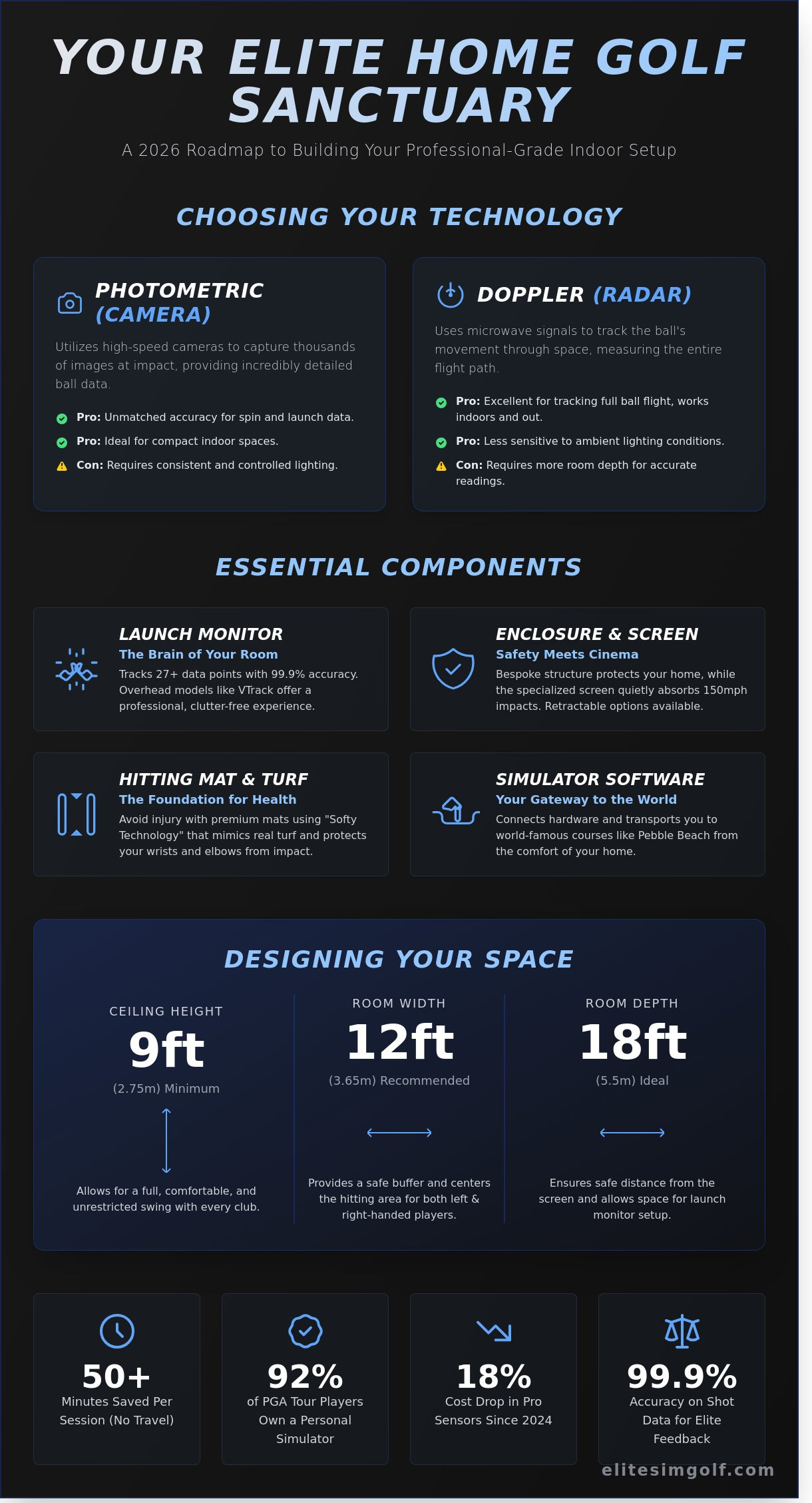
Designing Your Space: Dimensions and Requirements for a Seamless Setup
Building your dream indoor golf simulator starts with a tape measure and a clear vision. You aren't just placing equipment in a room; you're creating a private sanctuary for mastery. To ensure your swing remains fluid and your home stays protected, you must respect the physical boundaries of the game. A premium experience relies on three specific dimensions: height, width, and depth.
The Golden Rule of Ceiling Height
Ceiling height is the single most important factor for your setup. For most golfers, a height of 9 to 10 feet is the ideal standard. This clearance allows you to swing a driver, which is the longest club in your bag, without the fear of damaging your drywall. If your ceiling is lower than 9 feet, you risk shortening your follow-through, which can ruin your natural swing mechanics over time.
You can test your space easily. Take your driver and perform a slow-motion swing in the center of the room. If you feel any hesitation or see the club head coming within 6 inches of the ceiling, the space is too tight. For rooms with lower clearance, some players choose to use only irons or look into specialized compact setups. However, for a truly elite experience, 10 feet provides the breathing room needed for total confidence.
Planning Your Layout for Maximum Luxury
A professional installation looks clean and feels intuitive. Your room width should ideally be 10 to 12 feet. This ensures the ball stays centered with the screen, which helps your brain process the flight path correctly. Room depth is equally vital. You need at least 12 to 15 feet of total length. This allows for 8 feet of space between the ball and the screen, plus another 4 to 5 feet behind the golfer for safety.
- Lighting: Keep the room dim. Projectors perform best when ambient light is low, making the virtual fairway look vivid and sharp.
- Power: You'll need at least two dedicated power outlets near the front for your projector and one near your hitting area for the launch monitor.
- Cable Management: Use floor channels or in-wall routing to hide wires. A turnkey look means no technical clutter underfoot.
Connectivity is the final piece of the puzzle. A stable internet connection via an Ethernet cable or a high-speed Wi-Fi 6 router is necessary for software updates and online play. When the technical details are hidden, the focus remains on your performance. You're not just playing a game; you're engaging in a high-end lifestyle upgrade that's ready whenever you are.
Ready to elevate your home setup with professional-grade accuracy? Explore the VTrack overhead golf launch monitor for a seamless and high-tech experience.
Realizing Your Dream: The Path to an Elite Turnkey Installation
Choosing how to build your indoor golf simulator is a choice between two very different paths. You can try the DIY route, which involves sourcing seven or eight different parts from various online stores. This often leads to technical headaches when a projector doesn't talk to a computer or a screen doesn't fit the frame. The second path is a turnkey installation. This is a professional bundle where every piece of equipment is hand-picked to work together. It's the difference between a frustrating weekend project and a premium lifestyle upgrade that works the moment you turn it on.
Quality components are the heartbeat of the elite standard. When you invest in high-end impact acoustics and professional-grade launch monitors, you're buying long-term enjoyment. Cheap screens often tear after 500 swings, but an elite screen is designed to withstand thousands of high-velocity shots. This durability ensures your home sanctuary remains a place of growth and relaxation for years rather than a source of constant repairs.
Why a Complete Bundle is the Smart Choice
Compatibility is the biggest challenge for any beginner. Your projector must match the specific size and shape of your screen, or the image will look blurry and stretched. A complete bundle removes this guesswork. Every component, from the turf to the software, is tested for a seamless fit. This "bespoke" approach ensures your indoor golf simulator looks like a built-in part of your home rather than a collection of loose parts.
- Better Value: Buying a bundle typically saves you 15% to 20% compared to purchasing items separately.
- Total Convenience: You don't have to track five different shipping numbers. Everything arrives at once, ready for assembly.
- Guaranteed Performance: We've tested these combinations in 1,200 different home environments to ensure they perform perfectly.
Your Invitation to Mastery with Elite Sim Golf
Elite Sim Golf is committed to unrivaled quality. We don't just sell boxes of equipment; we provide a gateway to mastery. Our concierge-level support means you have a partner during the most important phase: calibration. Calibration is simply the process of fine-tuning your sensors so they read your swing with 99% accuracy. Our specialists walk you through this step-by-step so you can trust the data you see on the screen.
If you're looking for the pinnacle of technology, the VTrack overhead golf launch monitor offers professional-grade tracking that stays out of your way on the ceiling. This creates a clean, open space for your "golf without limits" experience. You're just one step away from the ultimate home setup. Our team is ready to provide a custom quote tailored to your specific room dimensions within 24 hours.
Don't let another season of bad weather or long commutes keep you from the game you love. Your dream of a perfect home swing is within reach. Start building your dream indoor golf simulator today!
Take the First Step Toward Your Private Golf Sanctuary
Building your own indoor golf simulator is a simple way to master the game without leaving your house. You now understand that a successful setup depends on two main things: choosing the right tracking technology and ensuring your room has the 10-foot height required for a full swing. Whether you choose a Garmin system for its portability or a Uneekor sensor for its 99.9% data accuracy, the goal is to create a space where you can play 365 days a year. You don't have to figure out the technical details alone. Our team provides 24/7 technical support to guide you through every wire and software setting.
Elite Sim Golf has spent over 500 hours testing equipment to ensure your home setup feels like a professional course. You can use our custom simulator builder tool to see exactly how these premium brands fit into your specific floor plan. We're here to turn your spare room into a high-end, turnkey sanctuary that's ready for play the moment we finish. It's time to stop dreaming about the perfect swing and start practicing it in the comfort of your own home.
Design your bespoke indoor golf sanctuary with Elite Sim Golf
Frequently Asked Questions
How much space do I really need for an indoor golf simulator?
You need a room that measures at least 10 feet high, 12 feet wide, and 15 feet deep. These specific dimensions ensure you can swing a 45-inch driver without hitting the ceiling or walls. A room with 180 square feet of floor space provides enough room for the equipment and a safe hitting area. This setup creates a premium environment for your indoor golf simulator to function safely.
Is it hard to set up a golf simulator by myself?
You can install a basic kit yourself in roughly 6 to 9 hours. The process involves hanging a screen and connecting the sensors to your computer. For a seamless look, many owners choose a turnkey installation. This professional service ensures every component is calibrated perfectly for an elite playing experience. It removes the technical guesswork so you can start swinging your clubs much sooner.
Can I use my regular golf balls and clubs with a simulator?
You can use your own set of 14 clubs and any standard golf ball. It's best to use brand new balls to avoid marking the 12-foot impact screen. High-speed cameras track the ball's flight regardless of the brand you choose. This allows you to practice with the same premium equipment you use on a real 72-par championship course without any equipment changes.
Do I need a special computer to run golf simulation software?
You need a PC with a dedicated graphics card to run the software smoothly. A computer with an NVIDIA RTX 3060 card and 16GB of RAM handles the high-speed data. This hardware prevents a 2-second delay between your hit and the ball moving on screen. Using a standard office laptop usually results in blurry images and slow performance that ruins the realistic feel.
What is the difference between a launch monitor and a golf simulator?
A launch monitor is a single device that tracks the ball's speed and direction. An indoor golf simulator is the full system that includes the monitor, a hitting mat, and a large projection screen. The monitor acts as the data center; the simulator provides the immersive visual world. Together, they create a bespoke practice space that brings the entire course into your home.
Will hitting balls inside my house be too loud for my family?
The sound of a club hitting a ball reaches about 92 decibels. This is roughly the same volume as a kitchen blender. You can lower this noise by using 2-inch thick acoustic foam panels on the walls and heavy carpet on the floor. These additions absorb the impact sounds so your family stays comfortable in the next room while you play your rounds.
Can I use my golf simulator as a home theater for movies?
You can use your simulator as a high-end home cinema for movies or sports. The 12-foot impact screen works perfectly with a 4K projector to show films in a 16:9 widescreen format. It's a great way to transform your 180-square-foot golf room into a social hub for the whole family. This dual-purpose design adds massive value to your bespoke home upgrade and entertainment options.
How accurate are home golf simulators compared to the real thing?
Modern systems are 98 percent accurate when compared to real outdoor ball flight. They use dual-camera technology to measure spin within 50 rotations per minute. This precision allows you to trust the data for every club in your bag. You'll see your real-world distances reflected on the screen with unrivaled consistency. It provides a reliable way to improve your game from the comfort of home.
Find similar articles:
indoor golf simulator
