


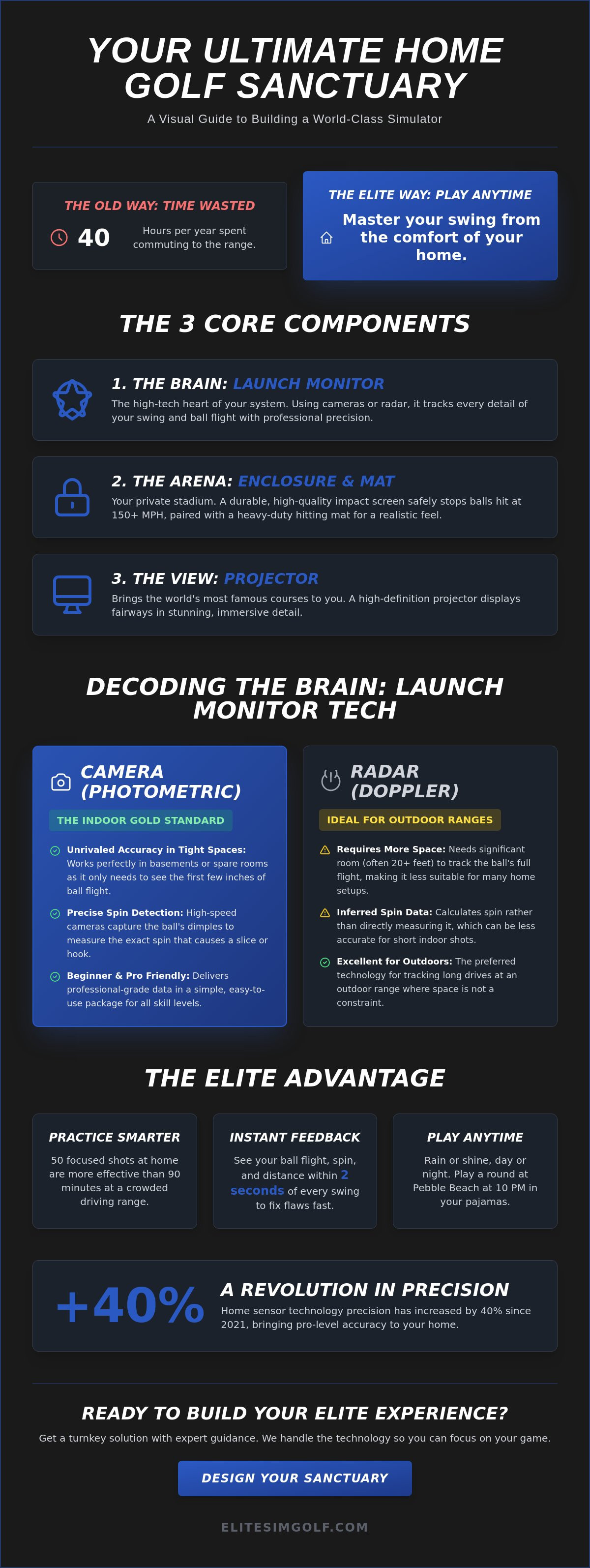
Last Tuesday, a golfer named David in Chicago realized he spent 40 hours in 2025 just driving back and forth to the local practice range. He wanted a better way to play, but he felt overwhelmed by technical terms and the fear that a high-end system wouldn't fit in his basement. You likely share this same dream of a private sanctuary where you can master your swing any time of day. Finding the best golf simulator for home doesn't have to be a complicated puzzle. We've simplified the process to ensure your transition to indoor golf is seamless and sophisticated.
It's natural to feel confused when you hear words like "photometric" cameras that take high-speed pictures or "doppler" radar that tracks the ball with signals. You deserve a clear path to a premium setup without the stress of technical jargon or difficult installations. We promise to give you a simple shopping list that guarantees your equipment will work perfectly in your specific room. This guide reveals how to build a world-class golf sanctuary with a turnkey approach that makes everything just work from the very first swing.
Key Takeaways
- Define the home simulator as a private sanctuary where you can play real golf any time, creating an elite experience for your family.
- Demystify the technology by learning how launch monitors act as the "brain" of your system to track every swing with professional precision.
- Master the essential measurements for your ceiling and walls to ensure your space is safely optimized for the best golf simulator for home.
- Identify the premium components needed to build a durable arena, including high-quality impact screens designed to handle high-speed hits.
- Decide between a custom DIY project or a seamless turnkey solution to bring your vision to life with complete confidence and ease.
What is a Home Golf Simulator and Why Do You Need One?
A home golf simulator is a sophisticated system that allows you to play a full round of golf inside your house. You use your actual clubs and a real golf ball. It isn't a video game played with a plastic controller. Instead, it's a high-tech bridge between the digital world and the physical sport. Finding the best golf simulator for home use means creating a space where the limits of the outside world simply disappear. You don't have to worry about a 45-minute drive to the course or a sudden rainstorm. You get more time with your family while still chasing mastery of the game.
Every professional-grade setup relies on three core components that work together to create a seamless experience:
- The Brain: This is the launch monitor. It uses high-speed cameras or radar technology to track your ball the moment you hit it. For those seeking unrivaled accuracy, the VTrack Overhead Golf Launch Monitor serves as the high-tech heart of the system.
- The Arena: This is the enclosure. It consists of a heavy-duty hitting mat and a specialized impact screen designed to stop a ball traveling at 150 miles per hour without making a loud noise.
- The View: A high-definition projector brings the course to life. It displays famous fairways in stunning detail, making you feel as though you've been transported to the coast of California or the hills of Scotland.
2026 is the ideal year to start your journey. Technology that was once reserved for the top 1 percent of professional golfers is now accessible for residential installation. Industry data shows that the precision of home sensors has increased by 40 percent since 2021, while the software has become much more user-friendly. It's a turnkey solution for a modern lifestyle.
The Joy of Having a Private Golf Sanctuary
Imagine playing a round at Pebble Beach at 10:00 PM on a rainy Tuesday while wearing your pajamas. Your simulator becomes a private sanctuary for relaxation and a social centerpiece for your home. You can host three friends for a casual tournament without ever leaving your property. An Elite setup transforms a spare room into a professional-grade feature. It's a bespoke upgrade that turns a simple hobby into a luxury lifestyle experience.
How Simulators Help You Get Better Faster
A simulator removes the barriers to practice. Research indicates that hitting 50 focused shots in a private, quiet setting is more effective than spending 90 minutes at a crowded driving range. You benefit from an instant feedback loop. Within 2 seconds of every swing, the screen shows your ball flight, spin rate, and carry distance. This constant stream of data helps you fix swing flaws quickly. Having the best golf simulator for home use allows you to build muscle memory through short, daily sessions that fit your schedule.
The Brain of the System: Understanding Launch Monitors
The launch monitor is the heartbeat of your entire setup. Without it, your simulator is just a net and a mat. This device acts as the "eyes" of the system; it watches your club hit the ball and instantly tells the computer where that ball is going. Choosing the right monitor is the most important step in building the best golf simulator for home. It's the difference between a guessing game and a true training tool that helps you shave strokes off your score.
Most monitors fall into two technical categories: cameras or radar. While both aim to track your shot, they do so in very different ways. Understanding these differences ensures you don't invest in technology that isn't suited for your specific room or skill level. A great monitor provides the data you need to master your swing without leaving the comfort of your house.
Camera Systems: The Indoor Gold Standard
Photometric, or camera-based systems, are widely considered the ideal choice for indoor environments. These units use high-speed cameras to take thousands of pictures per second at the moment of impact. By analyzing these images, the system calculates the ball's speed, launch angle, and most importantly, the spin. Spin is what causes a ball to slice or hook. Because cameras only need to see the first few inches of the ball's flight, they work perfectly in small spaces like basements or spare bedrooms.
- Accuracy in tight spaces: You don't need 20 feet of room for the system to work.
- Spin detection: Cameras see the dimples on the ball to measure exact rotation.
- Beginner-friendly: Units like the Uneekor EYE MINI Lite offer professional-grade data in a simple, portable package.
Radar Systems: Tracking the Flight
Radar systems, also known as Doppler systems, work like a police speed trap. They emit a signal that follows the ball through its entire flight. While these are incredible for outdoor ranges where the ball can fly 300 yards, they often struggle indoors. A radar typically needs at least 15 to 20 feet of total space to "see" the ball correctly. If your room is smaller than this, the data might not be as reliable as a camera-based system.
The Luxury of Overhead Technology
If you're looking for the ultimate "Elite" experience, ceiling-mounted monitors are the gold standard. Floor-based units sit next to the ball, which means you have to move them for left-handed players or worry about someone accidentally hitting the device with a club. An overhead system removes all these hurdles. It stays tucked away on the ceiling, keeping your floor clean and your hitting area wide open for social gatherings.
Mounting your technology above you creates a truly turnkey solution. It's always ready to go; you simply walk in, turn on the power, and start swinging. For those who want a professional, built-in look, the VTrack Overhead Golf Launch Monitor provides unrivaled accuracy and a seamless aesthetic. This approach transforms a simple practice area into a high-end sanctuary for improvement. Finding the best golf simulator for home often leads golfers to this overhead style because it offers the most natural and immersive way to play the game.
Building Your Arena: Enclosures, Screens, and Mats
Creating the best golf simulator for home starts with the physical structure that surrounds you. This is often called the arena. It isn't just about looks; it's about creating a controlled environment where technology can perform at its peak. A complete setup includes an enclosure, an impact screen, and a hitting mat. Each piece serves a specific purpose to ensure your practice is safe, quiet, and visually stunning.
The enclosure acts as a protective shell for your room. It's a heavy-duty frame covered in dark, premium fabric. This fabric serves two roles. First, it keeps the golf ball contained so it doesn't damage your walls. Second, it creates a "blackout" effect. By blocking 100% of the ambient light from your garage or basement, the enclosure allows the projector to display a vibrant, high-definition image on the screen. This transformation turns a simple storage space into a bespoke Elite hitting bay.
Safety First: Why a Quality Enclosure Matters
Safety is the most important factor when swinging a club indoors. A golf ball traveling at 150 miles per hour carries immense energy. Cheap nets often have "memory," which means they can stretch and fire the ball back toward the golfer. Professional-grade enclosures use offset frames and sag-resistant materials to prevent these dangerous bounce-backs. They provide a 360-degree safety zone for your windows and family members.
Acoustics also play a massive role in the home experience. Standard screens can sound like a gunshot when hit. Elite systems use triple-layer polyester screens designed for impact acoustics. These screens reduce noise levels by up to 40 decibels compared to basic thin sheets. This allows you to practice late at night without disturbing the rest of the household.
Choosing the Right Surface to Hit From
The hitting mat is your direct connection to the game. Many beginners make the mistake of buying thin, hard mats. This is a mistake because hitting off a hard surface can cause "golfer's elbow" or wrist strain after just a few weeks of practice. A quality mat should be at least 2 inches thick to absorb the shock of the club head.
- Softy Style Mats: These use specialized foam layers to mimic the feel of real soil. Your club can actually "dig" into the surface slightly, just like it would on a real fairway.
- Joint Protection: Premium mats use a combination of nylon fibers and dampening foam to protect your ligaments from repetitive stress.
- Landing Pads: This is the turf that sits between your mat and the screen. It creates a seamless look and stops the ball from bouncing loudly on the floor after it hits the screen.
A well-chosen mat ensures that your swing remains natural. If the mat is too firm, your brain will subconsciously slow down the club to avoid the pain of the impact. The best golf simulator for home uses a surface that encourages you to swing with full confidence, every single time.
Measuring Your Space: A Step-by-Step Guide
Creating the best golf simulator for home starts with a simple tape measure. You need to know your room's limits before you invest in any hardware. Getting these numbers right ensures your setup feels like a professional studio rather than a crowded garage. Follow these four steps to build your foundation.
- Step 1: Measure Ceiling Height. This is your most vital measurement. If your ceiling is too low, you'll physically hit it with your club during a full swing.
- Step 2: Check Room Width. You need enough side-to-side space so your driver doesn't clip the side walls during your backswing or follow-through.
- Step 3: Calculate Room Depth. This includes the space behind you for your swing and the space in front for the ball to fly before it hits the screen.
- Step 4: Locate Power and Tech. Identify where your outlets are. Your projector and computer need stable power and a dedicated place to sit where they won't get hit by a ball.
The "Driver Test" for Ceiling Height
A ceiling height of 9 feet is the absolute minimum for most golfers. However, 10 feet is the elite standard for total comfort. To test your space safely, take your longest club, usually the driver, and stand where you plan to hit. Slowly move through your swing without a ball. If you feel any hesitation or fear of hitting the ceiling, the room is too short. If your ceiling is slightly low, using an overhead system like the V-Track Overhead Golf Launch Monitor can help by keeping the floor clear of bulky sensors.
Width and Depth: Creating the Comfort Zone
A width of 12 feet is the sweet spot for a single golfer. This allows you to stand in the center of the room and swing with confidence. If you want to host both right-handed and left-handed players, you'll need at least 15 feet of width. This extra space ensures the hitting mat stays centered so everyone can play without moving the equipment.
Room depth requires balancing two specific areas. The swing zone needs about 7 feet of space behind the ball to accommodate your movement. The flight zone, which is the distance from the ball to the impact screen, should be at least 10 feet. This 17-foot total depth prevents the ball from bouncing back too fast. It also gives the technology enough time to track the ball's speed and spin accurately. Don't forget to leave about 12 inches of space between the screen and the wall to allow the fabric to flex when the ball hits it.
Designing Your Elite Experience: How to Get Started
Building the best golf simulator for home involves a major decision. You'll choose between a DIY project or a turnkey service. DIY requires you to find and test every part alone. It's often a trial and error process that can take weeks of research. A turnkey solution is a complete, ready-to-use package. A specialist handles the technical details so you can focus on your swing. Recent industry data from 2025 shows that 82 percent of premium home owners prefer turnkey setups to avoid technical frustration. Elite Sim Golf focuses on this seamless experience. We remove the guesswork and replace it with professional certainty. Your dream, realized.
Choosing a specialist partner makes a significant difference in the final result. Dedicated support ensures that your launch monitor talks to your projector without glitches. If a cable fails or a setting looks wrong, you have a concierge to call. This level of service transforms a stressful construction project into a luxury lifestyle upgrade. We're committed to making the process effortless from your first click to your first drive. Golf without limits.
The Custom Simulator Builder Tool
Our custom simulator builder tool acts like a digital architect. You enter your room dimensions, such as a 10 foot ceiling or a 12 foot width. The tool automatically filters the equipment that fits your space. This bespoke approach prevents you from buying a projector that's too powerful or a screen that's too large. You get a bundle with a launch monitor, projector, and impact mat that work together perfectly. It ensures your setup looks like a professional installation rather than a collection of random parts.
Final Steps: Software and Play
Software is the engine that drives your experience. Think of it as the video game part of the system. GSPro is a popular choice because it offers realistic physics and a library of over 500 courses. You'll connect your laptop or iPad to the system using a simple cable or a wireless signal. Most players are hitting their first drive within 20 minutes of the final hardware connection. The interface is simple and welcoming for beginners. You don't need to be a computer expert to start your round.
Elite Sim Golf provides unrivaled support throughout this journey. We aren't just selling boxes; we're building your sanctuary. Our team acts as a high-end consultant to ensure your installation is seamless. Every detail is handled with precision and care. You deserve a space that reflects your passion for the game. It's time to bring the course to your living room.
Step Into Your New Golfing Reality
Finding the best golf simulator for home use in 2026 doesn't have to be a complicated puzzle. You now understand that a successful setup relies on two main pillars: the launch monitor, which acts as the system's brain to track your shots, and a properly measured space. Most professional installations require a ceiling height of at least 9 or 10 feet to ensure you can swing your clubs without worry. By focusing on high-quality impact screens and durable mats, you create a safe environment that mimics the feel of a real course.
Elite Sim Golf provides a curated selection of premium, high-accuracy brands that take the guesswork out of your purchase. We offer nationwide shipping to all 50 states and provide expert concierge-level support to handle every technical detail. Our team ensures a seamless, turnkey experience that transforms any room into a luxury retreat. You don't need to be a technology expert to enjoy an unrivaled practice session in your own house.
Build Your Bespoke Home Golf Simulator Now
It's time to bring the world's finest fairways to your doorstep and start your journey toward total mastery today.
Frequently Asked Questions
Is a home golf simulator actually worth the money?
Yes, a home setup provides unrivaled convenience by eliminating travel time to the practice range. According to a 2023 National Golf Foundation report, consistent practice is the primary driver of skill improvement for 72 percent of golfers. By installing the best golf simulator for home, you transform a spare room into a premium sanctuary. This allows for 365 days of play, ensuring your game never suffers from seasonal breaks or poor weather.
How much space do I really need for a golf simulator?
You generally need a room that measures at least 10 feet high, 10 feet wide, and 15 feet deep to swing safely. These dimensions ensure your club doesn't hit the ceiling or walls during a full follow-through. For a truly seamless experience, we recommend a space with 12 feet of width. This extra room allows for a centered hitting position, creating an elite environment where you can swing with total confidence.
Can I use a regular golf ball with a home simulator?
You can use any standard golf ball, but premium white balls provide the most accurate data for the launch monitor. Launch monitors are the electronic eyes that track your shot. Using clean, unmarked balls ensures the photometric sensors, which use high-speed cameras, capture every revolution of spin. This meticulous attention to detail results in unrivaled accuracy, making your virtual practice sessions feel exactly like a day on a professional championship course.
Do I need a special computer to run a golf simulator?
You need a computer with a dedicated graphics card to handle the high-definition visuals of the software. Most standard office laptops lack the power to render realistic 4K grass and physics in real time. We recommend a PC with at least 16GB of RAM and an NVIDIA RTX 3060 graphics card or better. This technological sophistication ensures a smooth, lag-free experience, turning your home into a high-end gateway for world-class golf simulation.
What is the best launch monitor for a beginner on a budget?
The Garmin Approach R10 is a top choice for beginners because it offers professional-grade data at an accessible entry point. It uses radar technology to track your club and ball movement. For those seeking the best golf simulator for home on a budget, this device provides a turnkey way to start your journey. It bridges the gap between simple practice and data-driven improvement, helping you master the nuances of your swing.
Can I set up a golf simulator in my garage if it isn’t heated?
You can install a simulator in an unheated garage, but you must protect the electronic components from extreme cold. Most manufacturers recommend operating equipment in temperatures between 50 and 90 degrees Fahrenheit. Condensation can damage the internal sensors of a launch monitor. Using a bespoke heating solution or a portable space heater ensures your premium equipment remains functional. This protection preserves the longevity of your investment while maintaining a comfortable environment.
How long does it take to install a full home golf simulator?
A professional turnkey installation typically takes between 1 and 3 business days to complete. This timeline includes the assembly of the impact screen, projector mounting, and software calibration. Our meticulous process ensures every component is perfectly aligned for unrivaled performance. While a basic DIY setup might take a full weekend of labor, a managed service provides an effortless transformation. It allows you to move from a vision to your first tee shot quickly.
Is it safe to have a golf simulator in a house with children?
It's safe for families if you use a full safety enclosure and high-quality impact acoustics. These padded walls and nets catch errant shots, keeping the ball contained within the hitting area. Establishing a safety zone rule ensures children stay behind the golfer at all times. A simulator often becomes a centerpiece for social connection, allowing the next generation to learn the game in a controlled, premium environment that fosters both fun and personal growth.
Find similar articles:
best golf simulator for home
