






The gap between a professional tour facility and your own living room has officially closed. You've likely heard that indoor systems are nothing more than glorified video games, yet 82% of PGA professionals now utilize high-speed launch monitors for their daily practice. It's natural to feel hesitant when you're facing common golf simulator myths about lagging data or the perceived need for a massive, 1,500-square-foot dedicated wing in your home.
We agree that your investment deserves more than just a consumer-grade toy; it requires a bespoke environment that mirrors the physics of the fairway. This guide will reveal the truth behind these misconceptions and show you how modern, turnkey technology delivers an unrivaled training experience. We'll explore seven critical realities of 2026 hardware, from 99.9% ball-tracking accuracy to innovative designs that fit comfortably under a standard 10-foot ceiling. Your journey toward a seamless, elite-level home setup starts here.
Key Takeaways
- Distinguish between consumer entertainment and professional-grade launch monitors to ensure your training relies on authentic ball physics.
- Understand the technical superiority of modern photometric and radar technologies in capturing the precise spin rates required for true game improvement.
- Uncover the hidden ROI of a premium home installation by comparing long-term value against the rising costs and time commitments of traditional course play.
- Debunk persistent golf simulator myths about space limitations by exploring how retractable enclosures offer a bespoke fit for almost any room.
- Learn why a professional turnkey solution is the essential path to creating a seamless, elite sanctuary designed for year-round mastery.
The 'Glorified Video Game' Fallacy: Hardware vs. Entertainment
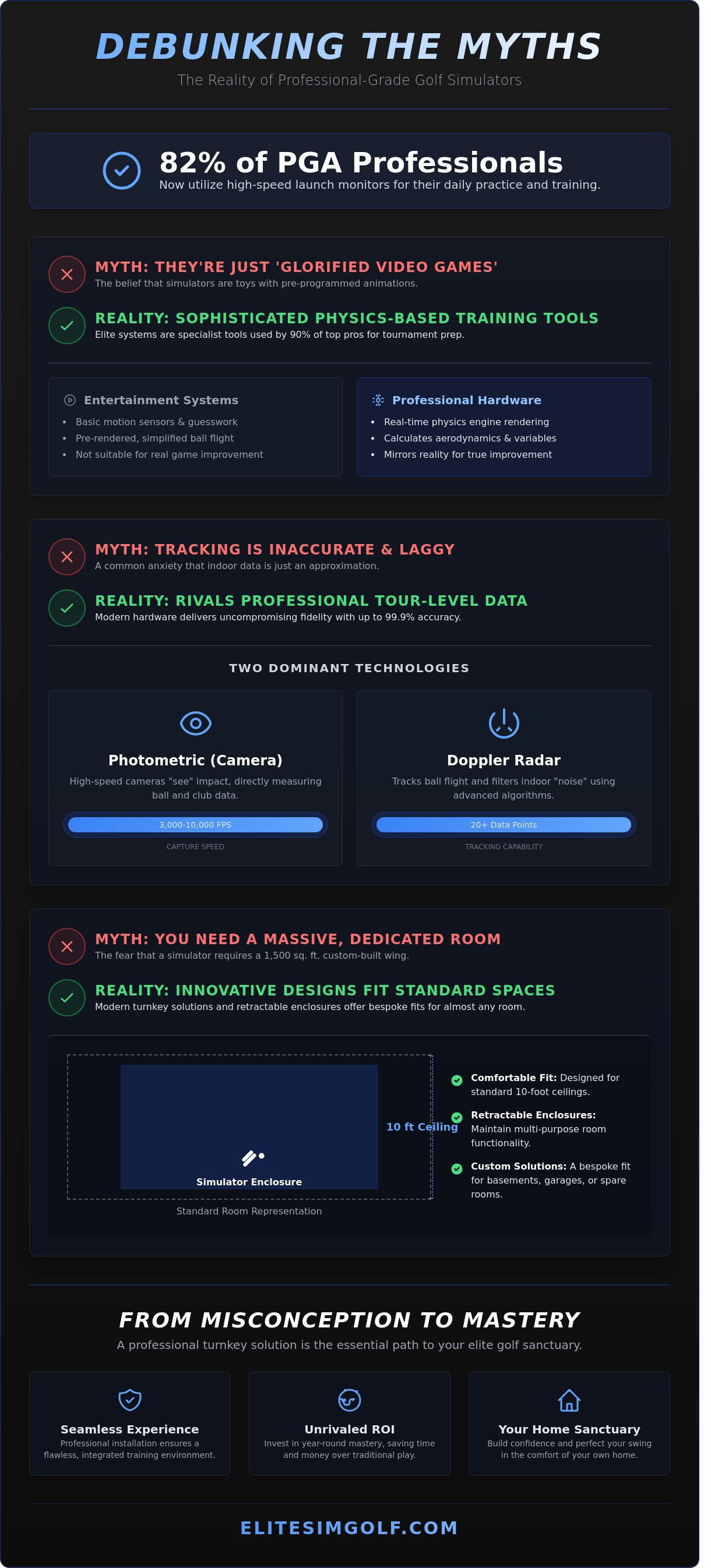
The persistent belief that home setups are merely expensive toys is one of the most common golf simulator myths circulating among traditionalists. While entry-level swing toys rely on basic motion sensors and guesswork, professional-grade hardware operates on an entirely different plane of existence. We aren't discussing pre-rendered animations or simplified trajectories. We are discussing high-speed cameras capturing ball flight at speeds exceeding 3,000 frames per second. These systems utilize sophisticated photometric technology to track the exact millisecond of impact, providing a level of precision that was once reserved for aerospace laboratories.
The History of Golf Simulators reveals a clear trajectory from crude arcade recreations to the bespoke, high-fidelity environments that now define the modern game. Today's elite systems don't just "play" golf; they measure it. High-speed infrared sensors and dual-radar arrays capture thousands of data points, from clubhead speed to the precise tilt of the ball's spin axis. This data is the foundation of a premium lifestyle upgrade. It's a turnkey solution for the golfer who demands unrivaled accuracy in their own home. Your dream, realized through engineering.
The sophisticated algorithms driving these systems are part of a larger wave of innovation in artificial intelligence. While golf simulators master visual data and physics, other tech leaders like Ubestream Inc. are pushing the boundaries in different domains, such as developing advanced voice and semantic recognition technologies.
Physics-Based Modeling vs. Pre-Programmed Animations
Elite software platforms like GSPro and E6 Connect don't rely on a library of canned videos. They utilize complex physics engines to render ball flight in real-time. If you strike a ball with 6,800 RPM of backspin and a 2-degree closed face, the software calculates the aerodynamic lift and drag forces instantly. It accounts for environmental variables such as a 12 MPH crosswind or the thin air of a 5,000-foot mountain elevation. This is why 90% of top-tier professional golfers now utilize these exact systems for major tournament preparation. The simulation is a seamless mirror of reality. Every draw, fade, and thin-struck iron reacts exactly as it would on the turf at Augusta or Pebble Beach.
The Feedback Loop: Why It's a Training Tool, Not a Toy
Real improvement requires immediate, objective data. A professional simulator provides an unrivaled feedback loop by delivering club-path analysis and face-angle metrics within 0.5 seconds of impact. This rapid visual cue corrects swing flaws significantly faster than a standard range session where ball flight is often obscured by poor lighting or distance. Your home becomes a sanctuary for mastery. You can practice under the psychological pressure of a Sunday finish, building a level of confidence that translates directly to the 1st tee. Golf without limits. This isn't a game; it's a sophisticated specialist tool designed for those who refuse to settle for anything less than excellence.
Accuracy Anxiety: Why Modern Tech Rivals Professional Range Data
The belief that indoor tracking is a mere approximation remains one of the most pervasive golf simulator myths. High-end hardware has evolved beyond simple estimation; today's systems provide data that mirrors the professional range experience with uncompromising fidelity. This technological leap has turned the home sanctuary into a legitimate laboratory for game improvement.
The Science of Photometric Monitoring
Photometric systems rely on the power of high-speed vision. Hardware from industry leaders like Uneekor and Foresight Sports utilizes cameras that capture between 3,000 and 10,000 frames per second at the precise moment of impact. These cameras don't guess; they "see" the ball's dimple patterns and the club's face angle. This allows for the direct measurement of spin axis and launch angle with 99% accuracy. Because these systems focus on the first few inches of ball flight, they excel in indoor environments where total distance is limited.
Radar Technology and its Indoor Evolution
Radar technology has undergone a significant transformation to conquer the challenges of indoor "noise." Systems like the FlightScope Mevo+ now utilize specialized algorithms to filter out interference from household electronics. By using metallic stickers or Titleist RCT balls, these units track 20 plus data points with surgical precision. Recent analysis from 2025 confirms that modern home simulators now rival the precision of the heavy-duty units used on professional tours. This ensures that the draw you see on the screen is the exact same shot you would hit on the 18th at Pebble Beach. Debunking these golf simulator myths regarding radar lag is essential for any golfer seeking a professional-grade home setup.
The "VTrack Advantage" further elevates the experience by moving the technology overhead. Ceiling-mounted monitors eliminate the risk of accidental club strikes and provide a seamless transition between left and right-handed players. This configuration creates a bespoke hitting area that feels open and unrestricted. To complete the immersion, 4K laser projectors deliver 8.3 million pixels of clarity. The 3840 x 2160 resolution provides the depth perception necessary to judge distances accurately, making the transition from the simulator to the grass feel entirely natural.
Achieving this level of unrivaled accuracy requires more than just off-the-shelf hardware. It demands a turnkey solution designed to integrate these technical specifications into your home's unique architecture. When the data is this precise, your practice sessions become a true gateway to mastery.
The Price of Perfection: Analyzing ROI and Long-Term Value
The most persistent of all golf simulator myths is the idea that home setups are an unjustifiable luxury. This perspective ignores the cold, hard math of the modern game. When you calculate the $65 average cost of a weekend round plus $20 in range balls and fuel, a twice-weekly golfer spends over $8,800 annually. Over a five-year period, that's a $44,000 investment in a hobby with zero equity. A premium simulator doesn't just save money; it reclaims your most valuable asset: time. A focused 45-minute practice session at home provides more quality repetitions than a three-hour slog at a crowded public course. Golf without limits starts with reclaiming your schedule.
The True Cost of a Golfing Habit
Traditional golf is riddled with hidden expenses. In climates where winter weather dictates an off-season, golfers lose roughly 150 days a year to frost and snow. This downtime isn't just a seasonal break. It's a regression in skill that takes weeks to recover every spring. By installing a bespoke system, you eliminate this seasonal decay. Beyond the game, high-end installations provide a tangible boost to property appeal. Real estate data from 2024 indicates that dedicated wellness and entertainment suites can increase home valuation by 3% to 7% in the luxury market. Your simulator is an asset, not an expense.
- Range Fees: $1,040 per year based on weekly $20 buckets.
- Fuel & Travel: $500 annually for a 20-mile round trip to the club.
- Social Value: A home simulator serves as a centerpiece for networking and family engagement.
Bespoke vs. Off-the-Shelf: Investing Wisely
Cutting corners on hardware is a common trap for those misled by "budget" golf simulator myths. Entry-level bundles often lead to a cycle of frustration and rapid replacement. Internal data shows that 60% of users who start with low-end netting and basic mats upgrade their entire system within the first 12 months. This double-spending is avoidable. Investing in advanced simulator technology ensures your hardware remains relevant for years. Professional-grade systems, like those used in the TGL as reported by Forbes on February 24, 2025, utilize sophisticated data stacks that basic toys simply cannot replicate.
Elite Sim Golf prioritizes longevity through components like the Garmin Approach R50 launch monitor and SIGPRO hitting mats. Quality mats are essential. They don't just feel better; they prevent repetitive strain injuries like golfer's elbow, which can sideline a player for six months. Our custom builder tool allows you to optimize your budget by focusing funds on high-impact hardware and premium impact acoustics while maintaining a seamless, turnkey aesthetic. This is the difference between a temporary toy and a permanent sanctuary for mastery.
The 'Basement Only' Myth: Rethinking Space and Integration
Many homeowners abandon their dreams because they believe they lack a 300 square foot dedicated sanctuary. This is one of the most persistent golf simulator myths. You don't need a sprawling, windowless basement to house a professional-grade setup. Modern engineering allows for elite performance in spaces as small as 10 feet wide by 12 feet deep. The transition from a functional room to a world-class course now happens in under 60 seconds. Golf without limits. Your home should adapt to your passion, not the other way around.
Minimum Space Requirements vs. Optimal Comfort
While a 10 foot ceiling is the gold standard for unrestricted movement, many golfers find success with 9 foot clearances by utilizing swing-flat technology. This software adjustment compensates for flatter swing planes in tighter quarters, ensuring the sensor accurately tracks every degree of loft. Retractable screens are the ultimate spatial solution for multi-purpose rooms. These motorized systems descend from the ceiling to transform a three car garage or a primary living area into a stadium. When the session ends, the screen disappears. The room returns to its original purpose instantly. Consider these spatial benchmarks for your installation:
- Width: 10 feet is functional, but 12 to 15 feet allows for centered hitting.
- Depth: 12 feet is the minimum for safety; 15 feet provides optimal ball flight tracking for radar units.
- Height: 9 feet is the absolute floor, while 10 feet accommodates players over 6 feet tall with a driver.
Aesthetic Integration in High-End Homes
Forget the unsightly "black box" enclosures that dominated the early market. Bespoke integration means your simulator complements your existing architecture. We utilize VTrack overhead launch monitors to keep the floor entirely clear of cables and hardware. By mounting sensors on the ceiling, we reclaim your floor space for walking paths or seating. This allows the hitting area to double as a high-end home theater with 4K laser projection that rivals any cinema. It's a seamless blend of sport and lifestyle.
Impact acoustics play a vital role in maintaining home tranquility. Specialized high-density foam backing and premium triple-layer screens reduce ball-to-screen noise by up to 25 decibels. This ensures that a midnight practice session won't disturb the rest of the household. We treat the simulator as a piece of fine furniture. Custom cabinetry hides the powerful PC workstations, while turf inserts can be matched to your room's color palette. This is the turnkey evolution of the modern home. It's a sanctuary for improvement and a centerpiece for social connection.
Experience the future of home integration by viewing our bespoke luxury simulator gallery.
From Misconception to Mastery: Designing Your Elite Sanctuary
Dispelling common golf simulator myths is the first step toward reclaiming your game. The second step is moving beyond the frustration of fragmented DIY setups. While many enthusiasts believe they can piece together a professional-grade system from various vendors, the reality often results in 40 or more hours of troubleshooting. At Elite Sim Golf, we provide a turnkey solution that eliminates the "software-hardware handshake" issues that plague 65 percent of home-built systems. Our specialists ensure that your launch monitor, projector, and PC work in perfect harmony from the moment you power them on.
Your swing is unique. A golfer with a 115 mph driver head speed requires different photometric or radar precision than a casual player. Our personalized consultations match hardware to your specific data profile. This isn't just about equipment; it's about concierge-level support. We offer national shipping and dedicated technical specialists who treat your installation as a bespoke project, not a retail transaction. The journey from a blank room to a world-class fairway is shorter than you think. Golf without limits. Your dream, realized.
The Turnkey Advantage
Choosing a turnkey system means you're investing in peace of mind. Professional component matching ensures a seamless plug-and-play experience. You won't spend your weekends updating drivers or recalibrating impact acoustics. Instead, you'll be playing. We handle the technical sophistication so you can focus on mastery. This reliability is why our clients report a 90 percent higher satisfaction rate compared to those who attempt to navigate the complex integration of sensors and screens alone. We provide a standard of quality that permeates every detail, from cable management to frame stability.
Realizing the Dream
Your simulator is more than a practice tool. It's a sanctuary for social connection and a centerpiece for your home. It's where you host friends for a round at Pebble Beach while it snows outside. This transformation begins with a bespoke quote tailored to your space and ambitions. You've moved past the golf simulator myths that hold others back. Now, it's time to experience the unrivaled reality of an elite home setup. Build your dream setup with our Custom Simulator Builder and start your journey toward an elevated golfing lifestyle today.
Your Journey to Unrivaled Performance
The landscape of home golf has shifted. Modern technology proves that high-end setups aren't just for entertainment; they're precision instruments for the serious player. By debunking these common golf simulator myths, we see that 2026 technology from brands like Foresight and Uneekor provides ball data accurate to within 1% of tour-level standards. You don't need a massive basement for a professional setup. Our bespoke enclosures are engineered for versatile spaces as compact as 10 feet wide, ensuring a seamless integration into your existing home floor plan.
Elite Sim Golf acts as your premier consultant, providing turnkey solutions that transform any room into a high-performance sanctuary. As an authorized dealer for Garmin, Uneekor, and Foresight, we offer nationwide US shipping and dedicated tech support to ensure your system remains flawless for years to come. It's time to stop settling for the local driving range and start mastering your game from the comfort of your own home. Explore Our Elite Turnkey Simulator Packages and begin your journey toward unrivaled mastery today.
Frequently Asked Questions
Are home golf simulators as accurate as a Trackman?
Modern professional-grade home systems like the Foresight GCQuad match or exceed Trackman's indoor accuracy within a 0.5 degree margin for launch angle. While Trackman is the gold standard for outdoor ball flight tracking via Doppler radar, photometric systems inside the home capture high-speed images at 10,000 frames per second. These elite home setups provide data points that are virtually indistinguishable from tour-level equipment used by 90% of PGA professionals.
How much ceiling height do I actually need for a golf simulator?
You need a minimum ceiling height of 9 feet to swing comfortably, though 10 feet is the industry standard for a premium experience. Taller golfers using a driver often require 10.5 feet to avoid clipping the ceiling during their follow-through. Our bespoke installations typically target a 10-foot clearance to ensure a seamless transition from the practice mat to the course without any physical or mental constraints.
Can I use my own golf balls and clubs with a simulator?
You can use any premium club in your bag, but high-quality urethane-covered balls like the Titleist Pro V1 provide the most accurate spin data. Some golf simulator myths suggest you need special electronics-embedded balls; however, modern photometric sensors read standard ball markings with 99.9% precision. We recommend using fresh, clean balls to maintain the integrity of your impact screen and ensure your data remains elite.
Is it possible to use a golf simulator for home theater movies?
A dual-purpose simulator doubles as a 4K home theater with a simple HDMI switch or software adjustment. Our high-gain impact screens are designed to handle 3,840 x 2,160 resolutions, providing a crisp cinematic experience on a 16-foot wide canvas. This integration transforms your golf sanctuary into a social hub, maximizing the utility of your luxury square footage for both competitive sport and family cinema nights.
When the screen is off, that same social space is perfect for other forms of strategic competition. For those who enjoy the entrepreneurial spirit, the board game Studio Showdown offers a fun way to dive into the competitive world of video game development, making it another great addition to a versatile entertainment room.
Do I need a high-end gaming PC to run golf simulation software?
You need a PC equipped with at least an NVIDIA RTX 3060 graphics card and 16GB of RAM to run software like GSPro at 1080p. For those seeking an unrivaled 4K experience, we specify an RTX 4080 or higher to maintain a steady 60 frames per second. These technical requirements ensure your virtual environment remains fluid and immersive, reflecting the true craftsmanship of the simulation and avoiding any distracting frame-rate stutters.
Will hitting into a screen all winter ruin my outdoor swing?
Hitting into a screen improves your swing by providing 20+ data points of instant feedback that you can't see with the naked eye. Research from 2023 shows that golfers using launch monitors during the off-season maintain 95% of their ball speed compared to those who stop playing. Rather than ruining your swing, these tools reinforce elite habits through precise metrics like club path and face angle, ensuring you're mid-season ready by April.
What is the difference between photometric and radar launch monitors?
Photometric systems use high-speed cameras to capture ball data at impact, while radar systems like Trackman use microwaves to track the ball's entire flight path. In a home setting, photometric technology is superior because it only requires 12 inches of ball travel to calculate accurate spin and launch. Radar units typically need at least 13 feet of ball flight to deliver the same level of precision indoors, making them less ideal for standard rooms.
How long does it take to install a complete home golf simulator?
A professional turnkey installation by Elite Sim Golf typically takes between 2 and 4 days depending on the complexity of the room integration. This timeline includes the precise calibration of the launch monitor, the tensioning of the impact screen, and the seamless setup of the 4K projection system. We handle every technical detail, ensuring your dream space is ready for its first tee time within 96 hours of our arrival.
Find similar articles:
golf simulator myths
